Define the service the tank will provide
A rainwater system can support a garden, certain cleaning tasks or other permitted non-potable uses. Supplying indoor fixtures or drinking water is a different level of responsibility. Begin by describing the use, the quantity needed and the months in which demand is highest. Check local collection and use rules before purchasing a tank or changing drainage.
A useful reserve does not have to replace the whole water supply. For some households, a modest garden supply is a practical first stage. For others, the main issue is continuity during interruptions, which may call for a separately planned safe drinking-water reserve rather than untreated roof runoff.
Look at rainfall timing, not only annual totals
Annual rainfall can conceal a long dry season. If most rain arrives when the garden needs little water, storage must bridge the gap between collection and use. Consult local meteorological records and consider unusually dry periods, not just an average year. The UK Met Office, Australia’s Bureau of Meteorology and the US National Oceanic and Atmospheric Administration are examples of public weather information sources; use the relevant service for your location.
For an initial volume estimate, rainfall in millimeters multiplied by catchment area in square meters gives a theoretical volume in liters before losses. An illustrative 10 mm of rain over 50 m² equals 500 liters before losses. Real collection is lower because of diversion, leaks, evaporation and the behavior of the roof and gutters. This arithmetic is a planning aid, not a tank-sizing guarantee.
Assess the catchment and collection path
Roof materials, surface condition, nearby trees, bird activity and airborne pollution can affect collected water. Some surfaces are unsuitable for particular uses. Have the proposed catchment assessed where contamination or material compatibility is uncertain. Do not assume that water is safe because it looks clear or has passed through a basic screen.
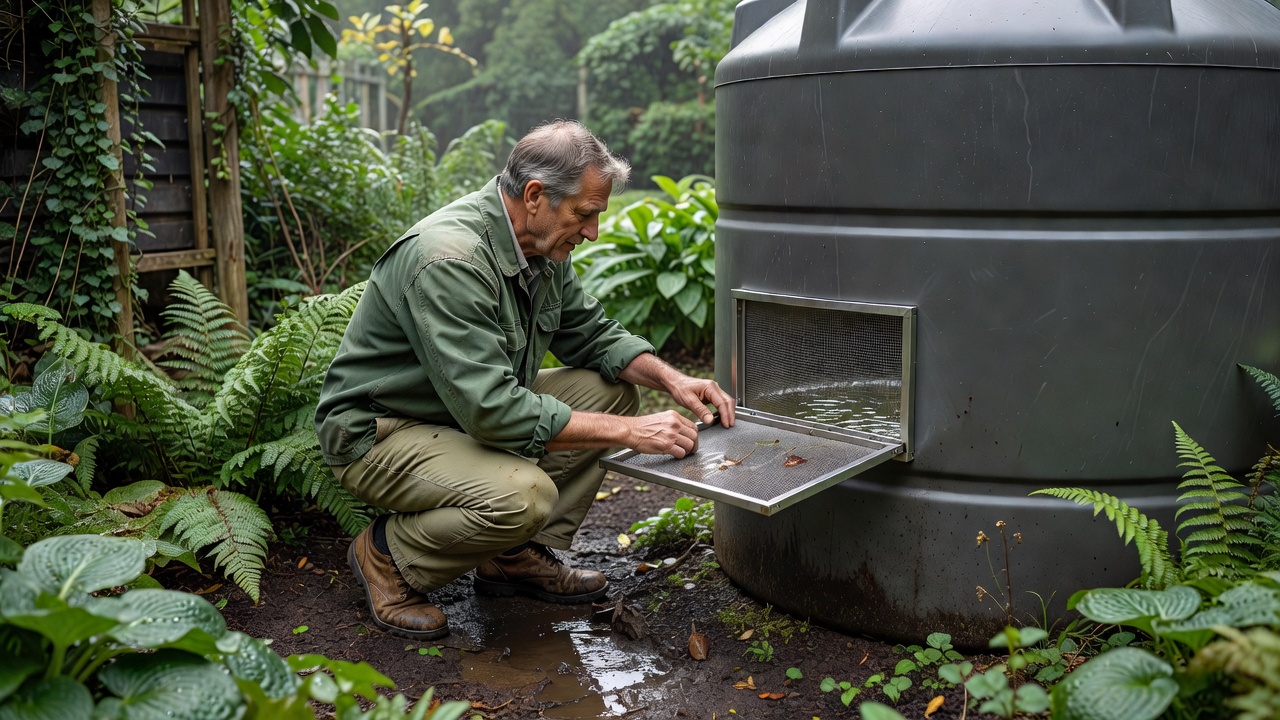
Accessible leaf screens and appropriate first-flush arrangements may reduce some debris and initial runoff contamination, but they do not make water potable. The system also needs a safe overflow route. Redirected water must not undermine foundations, flood neighboring land or create a drainage problem when the tank is full.
Make storage safe and maintainable
A full tank is heavy, so the foundation and placement must suit the equipment and ground conditions. Secure lids and access points against children, animals and accidental entry. Use appropriate insect screening and materials rated for the intended application. Tank entry is a confined-space hazard and is not an ordinary household cleaning task.
Think about access before settling on a location. Filters, inlets and any pump need inspection and servicing. Equipment hidden behind a narrow fence or dense planting may be neglected simply because maintenance becomes difficult. In cold climates, freezing protection and seasonal operation need specific assessment.
Keep drinking-water systems protected
Never create an improvised connection between collected rainwater and the public or household drinking-water supply. Cross-connections can contaminate water beyond the tank itself. Indoor non-potable uses may require permits, clearly identified pipework, approved backflow protection and installation by a qualified plumber.
If potable use is being considered, seek local public-health and qualified water-treatment advice. A suitable treatment train depends on the hazards present and requires ongoing maintenance and verification. Boiling does not remove every chemical contaminant, and a general-purpose filter is not evidence of drinking-water safety. The US Centers for Disease Control and Prevention provides drinking-water health information, while local authorities determine applicable requirements.
| Dependency | Planning question | Appropriate check |
|---|---|---|
| Collection permission | Is the intended collection and use allowed? | Local water or planning authority |
| Tank support | Can the site safely support a full tank? | Installer or qualified structural professional |
| Plumbing separation | How is drinking water protected? | Qualified plumber and applicable regulations |
| Overflow | Where does excess water go? | Drainage assessment |
| Pump supply | Will water remain accessible during an outage? | Water and backup-power planning together |
Connect water resilience to energy planning
A tank does not guarantee water at the tap if delivery depends on an unpowered pump. Record the pump’s operating and starting requirements when preparing an essential-load list. Gravity delivery may be possible in some designs, but elevation, pressure and structural safety need proper assessment rather than an improvised raised platform.
Keep a maintenance record with inspections, servicing and any testing required for the use. Review the system after storms, roof work or changes in water appearance or smell. A smaller, well-maintained reserve with a clear purpose is usually a more credible household asset than a larger system whose limits are unknown.
Account for pump powerPrepare a household brief